Projects
![[M.S. Thesis] AlphaSS : Protein Structure Prediction with Disulfide Bond Information](/assets/images/AlphaSS/alphass_image_0.png)
[M.S. Thesis] AlphaSS : Protein Structure Prediction with Disulfide Bond Information
Enhance AlphaFold2 by integrating disulfide bond embeddings and loss to improve prediction accuracy, especially in low-MSA scenarios.
1. Objective
- Enhance AlphaFold2 by integrating disulfide bond embeddings and disulfide loss to improve prediction accuracy, especially in low-MSA scenarios.
2. Approach
- In-depth Analysis: Conducted protein structure data analysis and feature extraction to identify key factors influencing structure prediction.
- Model Optimization: Developed and optimized a modified AlphaFold2 pipeline incorporating disulfide-specific features.
- Benchmarking: Rigorously benchmarked performance improvements against standard datasets to validate the effectiveness of the proposed method.
3. Results
- Significant Performance Gains: Observed a TM-score improvement of 2–3% under sufficient MSA conditions and 5–10% under insufficient MSA conditions.
- Enhanced Recall: Disulfide bond prediction recall improved by 50–100% with sufficient MSA, and by 60–100% when MSA was limited.
- Low-MSA Robustness: Validated that incorporating disulfide bond information particularly benefits prediction performance under data-scarce (low-MSA) conditions.
- Conference Presentation: Findings were presented at BIOINFO 2024.
![[LG Aimers 7th] Menu demand forecasting with N-HiTS & designed loss function](/assets/images/2025-09-18-ai-hackathon-2025-lg-aimers-7--ai-hackathon-/image.png)
[LG Aimers 7th] Menu demand forecasting with N-HiTS & designed loss function
[LG Aimers 7th Hackathon finalist] Time series forecasting using N-HiTS and LLM
[LG Aimers 7th Hackathon finalist]
1. Log Transformation & Data Normalization
- Log-transformed sales quantity targets for training stability (training/validation/prediction) → Inverse transformed for final results.
- Applied MinMaxScaling (0-1) to other covariates per series (store x menu).
2. N-HiTS Based Modeling Strategy
- Simple Temporal Split: Maintained time order.
- Multi-Window Validation: Set a sufficiently long validation span (42~56 days) to test multiple 28-day input → 7-day forecast windows for average performance.
- Consistency: Configured validation identically to the actual submission task ("predict next 7 days using last 28 days") to accurately assess overfitting/underfitting.
- Covariate Alignment: Split covariates at the same time steps as targets to prevent mismatch errors.
3. Evaluation Metrics & Loss Functions
- Adapted loss function approach due to different metrics in preliminary vs. final rounds.
- 3.1. Preliminary Round: Weighted SMAPE by store. Used oversampling on specific high-weight stores (e.g., 'Mirasia') to learn weights.
- 3.2. Final Round: SMAPE, NMAE, NRMSE, R-squared. Equal weights per store (no oversampling). Masked segments where target is 0 or negative as they are excluded from evaluation.
4. Cluster-Based Modeling
- Identified menus with residuals > 10 in validation data.
- Performed Spearman correlation-based cluster analysis on menus from the high-weight store ('Mirasia') with high residuals.
- Classified into 3 clusters based on similar trend patterns.
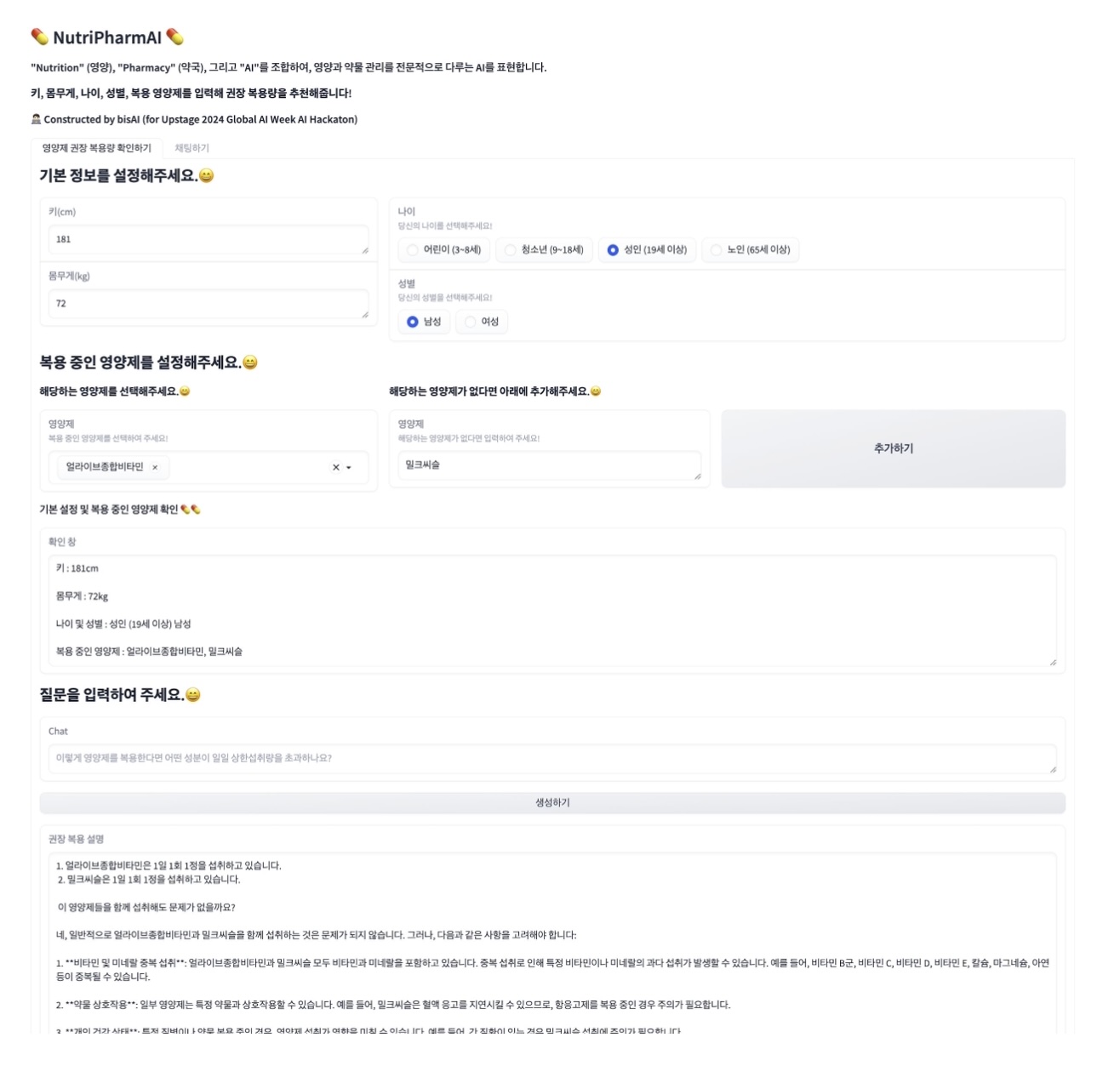
AI Parmacist Chatbot Service
[Upstage Global AI Hackathon finalist] RAG와 Langchain, Solar LLM Finetuning을 이용한 영양제 추천 서비스 개발
Finalist in Global AI Week Hackathon (Upstage AI Hackathon).
- Objective: Develop an AI-driven chatbot to assist with supplement and medication intake.
- Approach:
- Designed and implemented chatbot functionality using LLMs, Langchain, RAG, and Gradio.
- Optimized responses through retrieval-augmented generation (RAG).
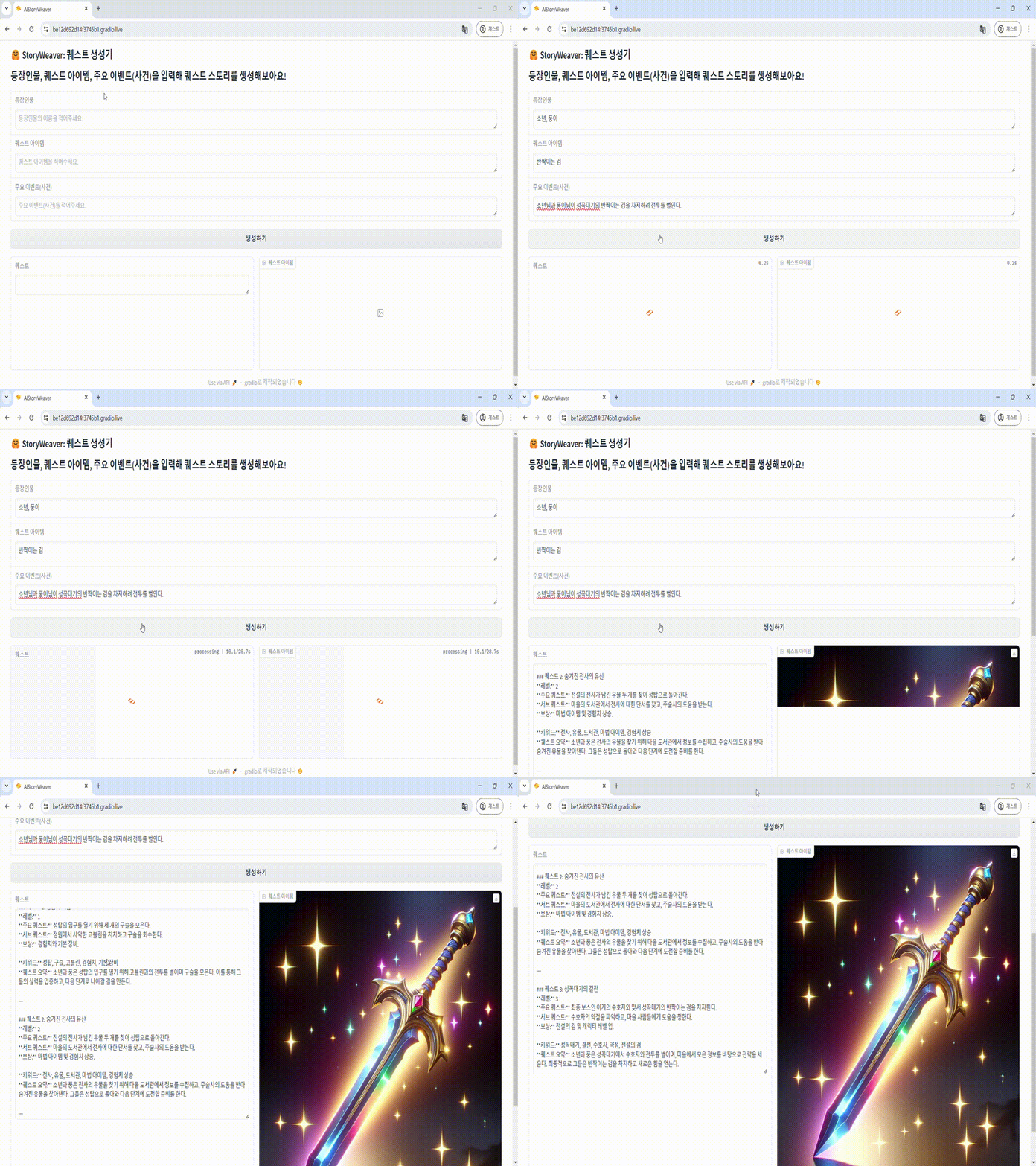
AI-driven Game Scenario Generator
[스마일게이트 퓨쳐랩 AI 서비스 위클리톤 대상 수상] LLM Finetuning 및 Prompt engineering을 통한 게임 시나리오 제너레이터 개발
1st place winner at Smilegate FutureLab AI Service Weeklython.
- Objective: Create an AI-based game scenario generator for dynamic content creation.
- Approach:
- Applied GPT fine-tuning, prompt engineering, and DALL·E.
- Developed an interactive UI using Gradio.
Development of an Automatic Defect Sorting System Module for Paper Containers Using AI-based Vision Inspection
NVIDIA JETSON NANO 및 Yolov5를 활용한 종이용기 불량품 자동 선별 시스템 모듈 개발
- Developed an object detection model using YOLOv5 and built a classification system using Jetson Nano.
- Constructed a dataset for detecting foreign substances in a local environment and fine-tuned a YOLOv5 baseline model.
- Optimized the model for deployment on Jetson Nano by applying model compression techniques.
- Achieved 95% accuracy in detecting foreign substances.
- Presented a poster at KSME2022 (The Korean Society of Mechanical Engineers).
Tech Stack
- YOLOv5
- Jetson Nano
- Python
- CUDA
- OpenCV
- PyTorch